The Best Plants for NYC Rooftop Gardens
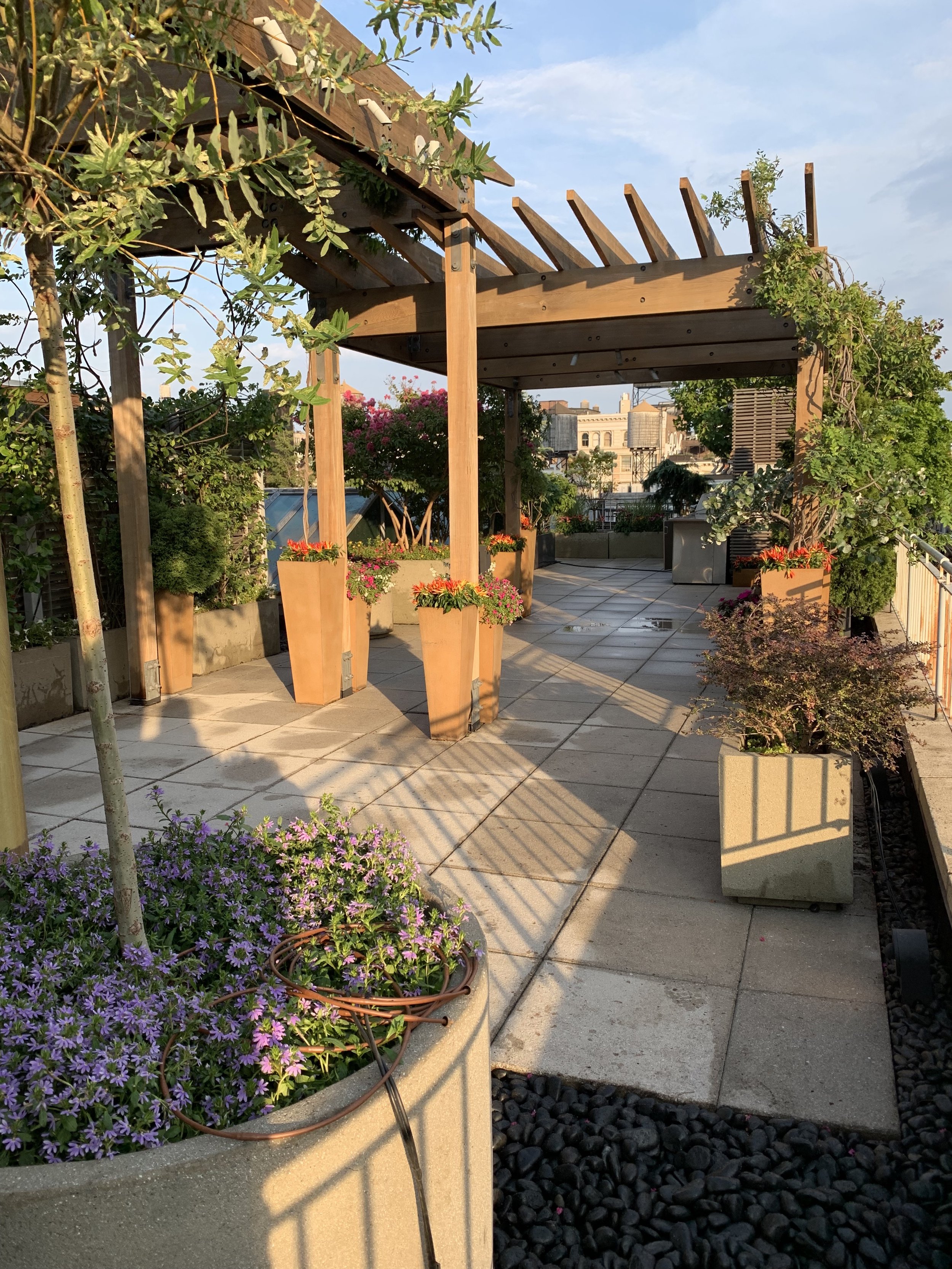
/NYC rooftops are some of the toughest growing environments in the country. Wind speeds at 200 feet can be double what you'd see at street level, summer surface temperatures on a black-roof membrane can exceed 150°F, and every plant lives its entire life in a container with limited soil volume. That rules out a huge percentage of plants that would thrive in a Brooklyn backyard one floor down.
The good news: a surprising number of trees, shrubs, perennials, and grasses are not just tolerant of rooftop conditions — they actively prefer them. The list below is drawn from plants we've installed and maintained on rooftops across Manhattan and Brooklyn organized by category so you can plan your space, not just pick favorites.
A quick note on context: rooftop microclimates vary block by block. What thrives on a 12th-floor Tribeca terrace with a wind-blocked southern exposure will scorch on a 30th-floor Midtown roof that catches wind from three sides. Use this guide as a starting point, not a recipe — and if you're working on a serious build-out, a site visit from a horticulturist will save you years of plant replacements.
What Makes a Rooftop Plant "Work" in NYC
Before the list, a quick framework. The best NYC rooftop plants share most of these traits:
Wind tolerance. Flexible stems, deep root systems, small or needle-like leaves that don't shred.
Drought tolerance. Containers dry out fast in wind and sun. Plants that need consistently moist soil struggle without aggressive irrigation.
Heat tolerance. Reflected heat from membranes, walls, and HVAC equipment can push effective temperatures well above ambient.
Cold tolerance. Containers freeze harder and faster than ground soil. A plant rated for USDA Zone 7 may behave like Zone 5 on a windy rooftop. Look for plants hardy to Zone 5 or colder when possible.
Compact growth. Trees and shrubs that stay under 12–15 feet, or take well to pruning.
Salt tolerance. Many NYC rooftops get salt spray off streets, and winter de-icing can drift up from sidewalks and HVAC drains.
With those filters in mind, here are the 25 plants we reach for most often.
Trees and Large Shrubs for NYC Rooftops
Rooftop trees provide vertical structure, privacy, and shade. The trick is finding species with compact growth, wind tolerance, and root systems that don't need to spread.
1. Serviceberry (Amelanchier spp.) A four-season standout — white spring flowers, edible summer berries, brilliant orange-red fall color, and elegant winter branching. Tolerates wind and reflected heat well. Multi-stem forms work best in containers. One of our most-used rooftop trees.
2. Japanese Maple (Acer palmatum) The classic sculptural rooftop tree. Slow-growing, stays manageable in containers for decades, and offers extraordinary fall color. Best in partially sheltered locations — exposed rooftops can scorch leaf edges. Dwarf varieties like 'Crimson Queen' work in smaller containers.
3. River Birch (Betula nigra) Wind-tolerant, fast-growing, with beautiful peeling bark. The multi-stem habit fits narrow rooftop spaces. Needs consistent irrigation in containers but otherwise low-maintenance. Avoid full-shade rooftops.
4. Kousa Dogwood (Cornus kousa) Smaller and more wind-tolerant than the native flowering dogwood, with later spring bloom that escapes most NYC frost damage. Stunning bracts in early summer, red fruit in fall.
5. Mugo Pine (Pinus mugo) A dwarf evergreen conifer that handles wind, salt, drought, and cold without complaint. Adds year-round structure and works as a low anchor in larger container groupings. Look for 'Slowmound' or 'Mops' for the most compact form.
6. Eastern Red Cedar (Juniperus virginiana) A native evergreen that thrives in exposed, windy sites. Provides excellent winter screening and habitat value. Slow enough to stay manageable for years in a large container.
Flowering and Foliage Shrubs
Mid-height structure that fills the gap between trees and perennials. These are the workhorses of a rooftop planting plan.
7. Smooth Hydrangea 'Annabelle' (Hydrangea arborescens) More wind-tolerant than the big-leaf hydrangeas most people picture. Massive white summer blooms, dies back to the ground each winter, and rebounds reliably each spring. A favorite for partially shaded rooftops.
8. Inkberry Holly (Ilex glabra) Native evergreen with a tidy mounded form. Tolerates wind, cold, salt, and poor soil — a near-perfect rooftop shrub. Use 'Shamrock' or 'Densa' for the most consistent shape.
9. Boxwood (Buxus sempervirens and hybrids) The classic formal evergreen. Look for cold-hardy varieties like 'Green Mountain' or 'Winter Gem'. Avoid in exposed wind tunnels — leaves can scorch — but excellent for sheltered rooftop courtyards.
10. Dwarf Lilac (Syringa meyeri 'Palibin') A compact lilac that stays under 5 feet, blooms reliably, and tolerates container life. The fragrance on a May evening is hard to beat. Wind-tolerant if rooted in a heavy container.
11. Russian Sage (Perovskia atriplicifolia) Technically a sub-shrub. Lavender-blue summer flowers, silvery foliage, drought-proof, and one of the toughest plants you can put on a rooftop. Thrives in baking sun and wind.
12. Caryopteris (Caryopteris × clandonensis) Late-summer blue flowers when most plants are tired, plus aromatic silver foliage. Excellent for hot, sunny, exposed rooftops. Cut back hard in early spring.
Perennials for Rooftop Color
Long-blooming, low-maintenance perennials provide the seasonal color that makes a rooftop feel like a garden rather than a planter display.
13. Coneflower (Echinacea purpurea) Native, drought-tolerant, attracts pollinators, and blooms from June into September. New cultivars come in nearly every warm color. A rooftop staple.
14. Black-Eyed Susan (Rudbeckia fulgida 'Goldsturm') Reliable late-summer gold, holds up to wind, and naturalizes well in larger containers. Pairs beautifully with ornamental grasses.
15. Sedum 'Autumn Joy' (Hylotelephium telephium) The most drought-tolerant flowering perennial on this list. Pink summer flowers age to coppery rust through fall. Bulletproof on hot, exposed rooftops.
16. Lavender (Lavandula angustifolia) English lavender — not the Spanish or French varieties — handles NYC winters in containers when planted in sharply drained soil. Full sun and minimal water are non-negotiable. 'Munstead' and 'Hidcote' are the most reliable cultivars.
17. Catmint (Nepeta 'Walker's Low') Long-blooming lavender-blue flowers, aromatic foliage, drought-tolerant, and almost indestructible. Cut back after the first flush for a second bloom.
18. Yarrow (Achillea millefolium) Flat-topped clusters in yellow, pink, red, or white. Tolerates poor soil, wind, and drought. One of the best plants for hot, exposed corners.
Ornamental Grasses
Grasses move with the wind instead of fighting it, which makes them ideal for rooftops. They also provide texture and winter interest most other plants can't match.
19. Blue Fescue (Festuca glauca) Compact silvery-blue mounds, perfect for the front of container groupings. Drought-tolerant and evergreen in mild winters.
20. Maiden Grass (Miscanthus sinensis) The tall ornamental grass. Adds 5–7 feet of vertical movement and excellent winter structure. Look for 'Morning Light' or 'Gracillimus' for compact forms — some cultivars get too large for rooftop containers.
21. Switchgrass (Panicum virgatum) A native prairie grass that's more upright and wind-stable than maiden grass. 'Shenandoah' has burgundy fall color; 'Northwind' stays narrow and never flops.
22. Feather Reed Grass (Calamagrostis × acutiflora 'Karl Foerster') The most upright ornamental grass — wind doesn't faze it. Blooms early summer, holds its golden seed heads into winter. A rooftop classic.
Herbs and Edibles
Rooftop conditions — full sun, good drainage, hot air — happen to be ideal for Mediterranean herbs. The same plants that struggle in muggy Brooklyn backyards thrive 100 feet up.
23. Rosemary (Salvia rosmarinus) Treat as an annual in containers (it rarely overwinters reliably in NYC) or bring indoors. Loves heat, sun, and dry soil.
24. Thyme (Thymus vulgaris and T. serpyllum) Hardy enough to overwinter in containers if drainage is sharp. Creeping varieties work as a living mulch around larger plants.
25. Sage (Salvia officinalis) Drought-tolerant, hardy in containers, and an attractive year-round presence. The variegated and purple-leaf cultivars earn their keep on looks alone.
A note on tomatoes, peppers, and herbs grown for harvest: they all work on NYC rooftops, but they're seasonal annuals that need replanting and active care. We don't usually include them in design plantings — they fit better in dedicated edible-garden containers maintained by the owner.
What to Avoid on NYC Rooftops
A few plants we'd steer away from, even though you'll see them in nurseries:
Big-leaf hydrangeas (H. macrophylla). Stunning in a backyard, but flower buds form on old wood that NYC winter wind kills back every year. You'll get foliage, not flowers.
Wisteria. Beautiful, but the root system and growth rate make it a long-term liability in containers.
Mature-sized maples, oaks, and most shade trees. Root systems too large, too slow to establish, too prone to wind damage.
Most rhododendrons and azaleas. Surface roots dry out fast, and most varieties hate wind and reflected heat.
Bamboo (running types). Roots will eventually breach containers. Clumping bamboos are the only acceptable option — and even then, treat with caution.
Container, Soil, and Irrigation Notes
Even the right plant fails in the wrong setup. A few rules we apply to every rooftop project:
Container size matters more than plant size. A small plant in a properly sized container outperforms a big plant in an undersized one. Trees need at least 24–30" deep containers; large shrubs need 18–24".
Weight is a structural concern. Wet soil is heavy. Always confirm rooftop load capacity with a structural engineer before installing large containers — this is non-negotiable on co-op and condo buildings.
Use rooftop-engineered soil. Standard potting mix is too dense and too heavy. Look for lightweight blends with expanded shale or pumice for drainage and weight reduction.
Drip irrigation is essential for anything more than a few pots. Hand-watering 50 containers on a rooftop is not realistic, and missed waterings kill plants fast in summer wind.
Wind anchoring matters. Trees and tall grasses need either heavy containers, internal staking, or both — especially in the first two years before roots establish.
Designing a Rooftop That Lasts
A great NYC rooftop garden isn't a plant list — it's a system. The right plants in the wrong containers, on a roof without irrigation, won't make it past August. The wrong plants in a beautifully designed space won't make it through their first winter.
At NY Horticulture Group, we design, install, and maintain rooftop gardens across all Manhattan and Brooklyn boroughs. Our team includes trained horticulturists who specialize in the realities of NYC rooftop growing — wind exposure assessments, structural load coordination, drip irrigation design, and ongoing maintenance programs that keep plantings looking like the day they were installed.
If you're planning a rooftop project — or trying to figure out why last year's plantings didn't make it — we'd love to take a look.