Brooklyn Backyard Garden Ideas: Small Space, Big Impact
/The typical Brooklyn brownstone backyard is about 20 feet wide and 40 to 55 feet deep — a narrow rectangle hemmed in by fences, neighboring buildings, and the back of your own house. It catches partial sun at best, drains poorly, and shares walls with neighbors whose windows look directly down into it.
It's also one of the most magical spaces you can own in New York City. A well-designed Brooklyn backyard is a private outdoor room you can step into from your kitchen and forget the rest of the city exists.
The trick is to stop thinking about a Brooklyn backyard the way you'd think about a suburban lawn. It's not a yard — it's a courtyard. The design priorities are different: zones, privacy, vertical interest, low-maintenance plants, and materials that wear well in shade and dampness. Below are the design moves we use most often when transforming small Brooklyn backyards from neglected concrete patches into genuine outdoor rooms.
Start by Zoning the Space — Don't Plant It
The biggest mistake people make in a Brooklyn backyard is treating the whole space as one thing. A 20-by-50-foot rectangle doesn't read as a garden when it's filled edge to edge with plants and a single patio set. It reads as cluttered.
The fix is to think in zones. Most successful Brooklyn backyards have two or three distinct zones running front-to-back from the house:
Zone 1: Just outside the back door. A hard surface — pavers, porcelain tile, or a wood deck — extending six to twelve feet from the house. This is your dining and entertaining zone. It should feel like an extension of the kitchen.
Zone 2: The middle. A transition area. This is where a tree, a planted bed, or a focal feature lives. Sometimes it's a small lawn (real or synthetic). Sometimes it's a gravel area with a single specimen tree.
Zone 3: The back. A more enclosed, planted zone — often a lounge area or a quieter seating spot, screened by plantings. This is the destination the rest of the garden points you toward.
Brooklyn backyards that work have a progression. You move through them. Brooklyn backyards that don't work are flat fields with stuff on them.
Build Privacy Vertically, Not Horizontally
You don't have horizontal room to spare. Every plant and structure has to do double duty, and the most valuable real estate in a Brooklyn backyard is up — the walls, fences, and overhead space.
Privacy moves that work:
Louvered or slatted fencing. Solid fences trap stagnant air and feel oppressive. Louvered cedar or ipe fencing lets air flow while breaking sight lines. The fence becomes a design feature, not a barrier.
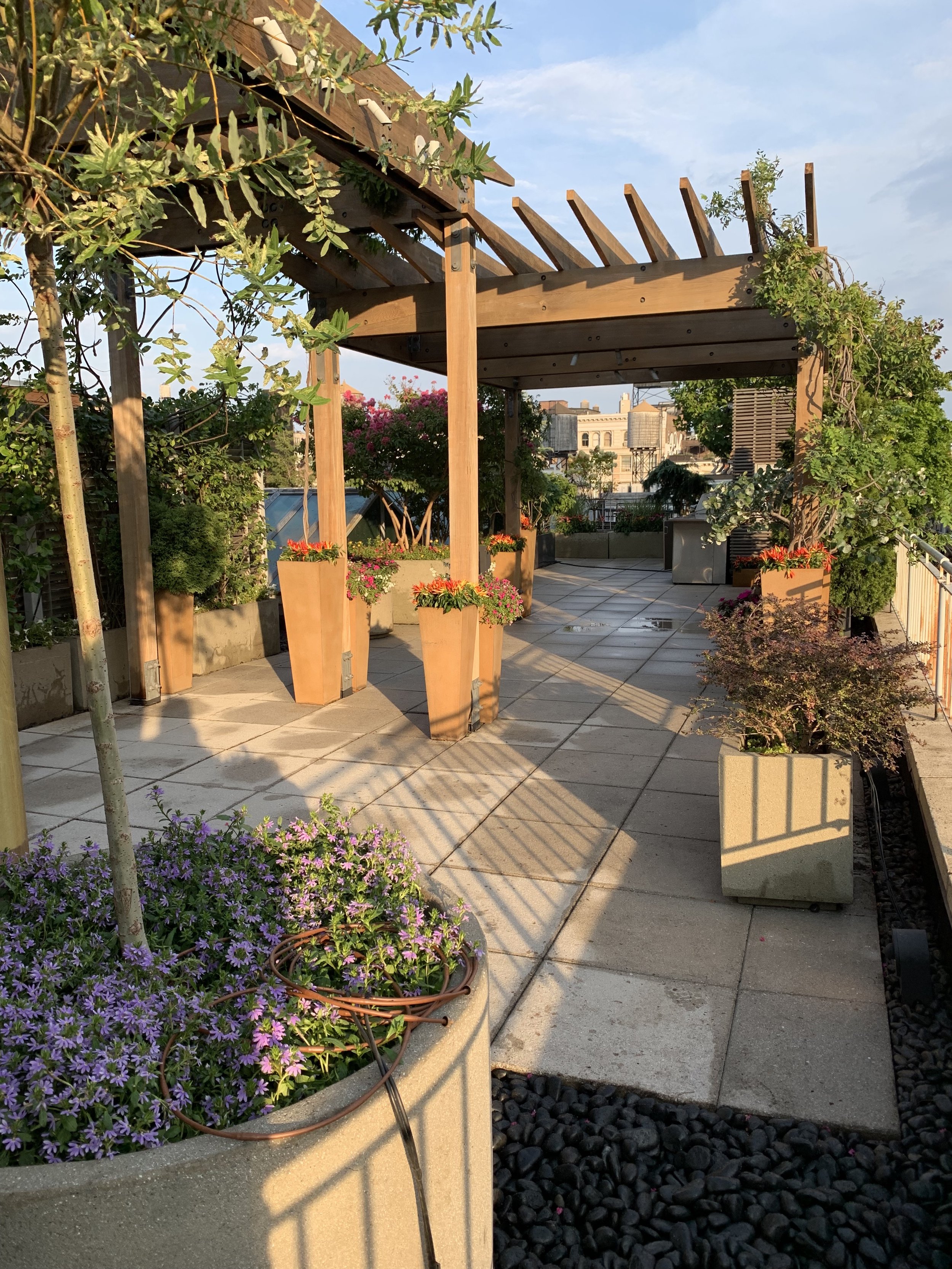
Overhead pergolas or trellises. Even a simple pergola over the dining area dramatically changes how enclosed the space feels — and once it's covered in climbing hydrangea, clematis, or wisteria, you have an overhead canopy that blocks upstairs neighbors' views.
Tall narrow trees against the fence line. Skinny columnar trees (more on these below) screen second-story windows without eating up floor space.
Climbing plants on the walls. Climbing hydrangea (Hydrangea anomala subsp. petiolaris) is the gold standard — it tolerates shade, attaches itself, and slowly transforms a flat brick wall into a green wall over a few years.
The goal is to make the space feel enclosed without making it feel small.
Choose Plants That Tolerate Brooklyn's Worst Conditions
Most Brooklyn backyards are partial shade to full shade for most of the day, with reflected heat off masonry walls, poor drainage, and compacted soil. That rules out a huge percentage of the plants you'll see at a garden center — and frees you to focus on a smaller palette that actually thrives.
Small trees that fit Brooklyn backyards:
Serviceberry (Amelanchier canadensis) — Brooklyn designers' near-universal favorite. Four-season interest, stays under 20 feet, and tolerates shade and urban soil. The single most-recommended Brooklyn backyard tree.
Japanese Maple (Acer palmatum) — Sculptural, slow-growing, and at home in a shaded brownstone backyard. A red-leaf cultivar planted against a brick wall is a Brooklyn classic.
Magnolia 'Little Gem' (Magnolia grandiflora) — A compact evergreen magnolia for the rare Brooklyn yard with enough sun. Stays under 20 feet, blooms in summer.
Redbud (Cercis canadensis) — Spring flowers directly on the bark, heart-shaped foliage, native, tolerates a range of conditions.
Shrubs and structural plants:
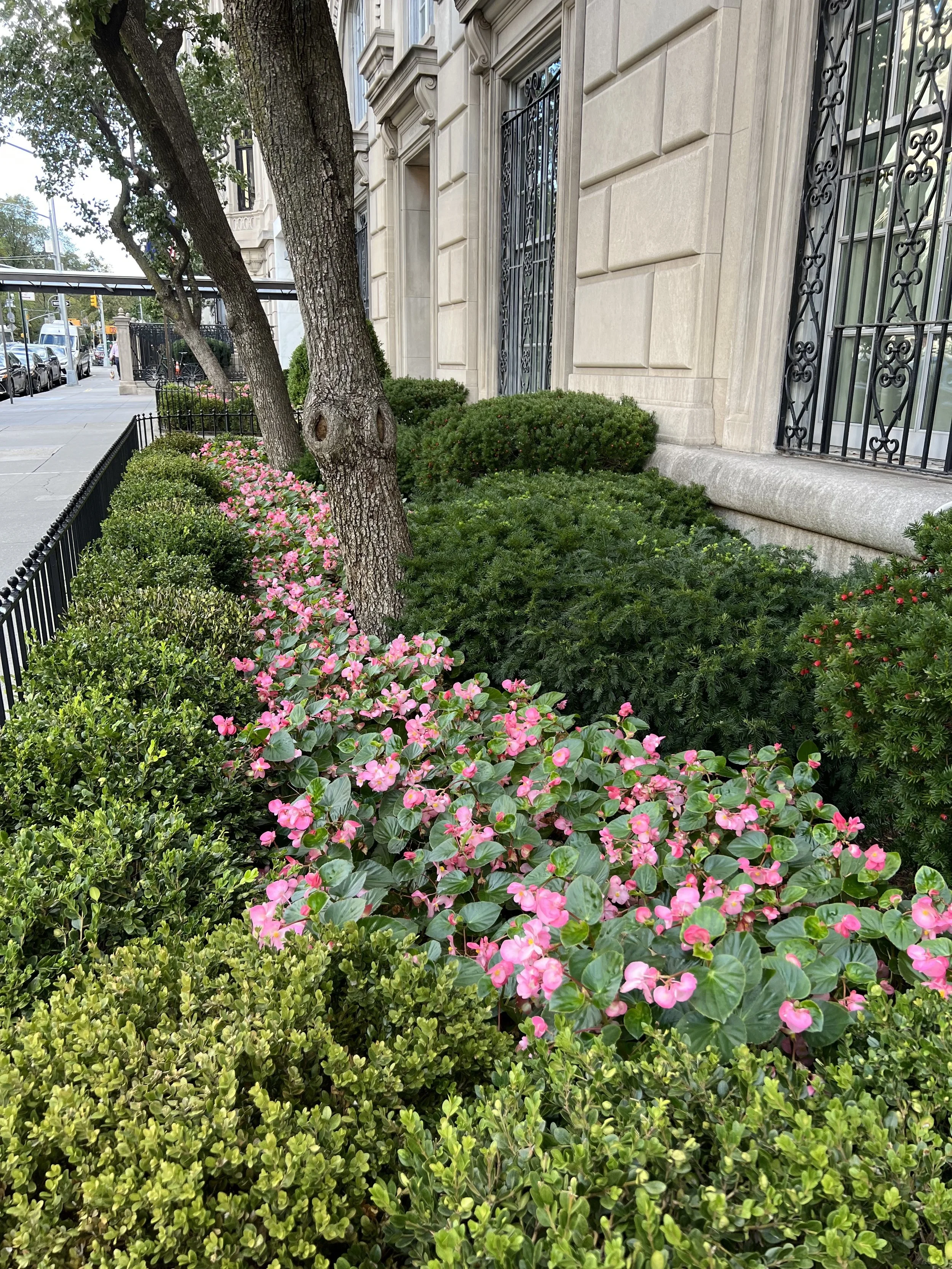
Boxwood (Buxus) — The brownstone backyard's structural workhorse. Holds form year-round and reads as architecture.
Hydrangea ('Annabelle' and 'Limelight') — Tolerate part shade, bloom reliably, and forgive Brooklyn soil.
Fothergilla — Native, white spring flowers, brilliant fall color, perfect mid-height shrub.
Inkberry Holly (Ilex glabra) — Native evergreen with a tidy form, an alternative to boxwood for those who want something more relaxed.
Perennials and ground covers for shade:
Hellebores — Winter and early spring blooms in dappled shade.
Heuchera (Coral Bells) — Foliage color from chartreuse to deep burgundy, semi-evergreen.
Hakonechloa (Japanese Forest Grass) — Cascading golden grass that thrives in shade and softens every edge it touches.
Epimedium — Underused, tough as nails, beautiful spring flowers, evergreen foliage.
Hosta — Yes, hosta. The right cultivar in the right spot anchors a Brooklyn shade garden.
A Brooklyn backyard doesn't need 50 plants. It needs 8–12 species, planted in repeating drifts, doing different jobs. For our full guide on plant selection, view this blog.
Pick Materials That Look Better as They Age
Brooklyn backyards are framed by century-old brick, ironwork, and stone. The materials you choose for the ground plane have to belong in that conversation. The mistake is using suburban materials — beige pavers, decorative concrete, plastic deck boards — that fight the surrounding architecture.
Materials we reach for most often:
Bluestone pavers — The default Brooklyn ground material. Looks correct in every brownstone backyard, ages beautifully, comes in a range of finishes from honed to thermal.
Ipe or cedar decking — Wood adds warmth that stone can't. Ipe is more expensive but lasts decades; cedar is more affordable and grays gracefully.
Pea gravel — Underrated. Drains well, feels good underfoot, costs a fraction of pavers, and reads as European garden rather than parking lot. Excellent in middle-zone areas.
Porcelain pavers — A newer option that mimics stone or wood, stays cool in summer, and doesn't stain. Best near the house where stains from food and drink are most likely.
Steel edging (Cor-Ten or galvanized) — Defines beds, holds gravel in place, and patinas into the architecture instead of fighting it.
Avoid: stamped concrete, pressure-treated lumber, mulch dyed unnatural colors, white plastic planters, suburban-style retaining wall blocks. They read as wrong in a brownstone context.
Design Around Brooklyn's Constraints
Some realities about Brooklyn backyards that out-of-town designers miss — and that should shape your decisions early:
No street access. Almost every Brooklyn brownstone backyard is accessible only through the parlor level of the house. Every bag of soil, every paver, every length of lumber comes in the front door, down the hall, and out the back. This affects what you can install and how much it costs. Heavy equipment is usually impossible. Plan for hand-carry-able materials.
Drainage is real. Brooklyn backyards sit below street grade in most cases, with neighbors' yards draining into yours. Standing water and damp basements are common. Solve drainage first — a French drain, dry well, or rain garden — before you spend a dollar on plants or pavers.
Sun is the limiting variable. Walk your yard at 9 a.m., noon, 3 p.m., and 6 p.m. on a sunny day and map exactly where the sun lands. Most Brooklyn backyards get direct sun for only a few hours a day, in a different spot each hour. That sun map dictates everything else.
Neighbors' trees matter. Your sun isn't just blocked by your own building. The honey locust two yards over and the tree-of-heaven in the alley are part of your light conditions. Map those too.
The fence isn't yours alone. Most Brooklyn fences are shared. Replacing one without talking to your neighbor creates problems. Plan early conversations, and consider that a louvered fence going up on your side is also going up on theirs.
What's Worth Splurging On (And What Isn't)
After years of Brooklyn backyard projects, the things that consistently earn their cost:
Worth splurging:
The hardscape. It's the bones of the space and the hardest thing to redo later. Cheap pavers will haunt you for fifteen years.
The tree. One beautiful specimen tree is the focal point of the entire backyard. Buy the biggest one you can fit through the door (or have craned in if access allows). Trees are the only element where age really shows.
Drip irrigation. Containers and beds in shaded yards still need water in summer. A simple drip system on a timer is the difference between a garden that survives August and one that doesn't.
Outdoor lighting. A Brooklyn backyard is used as much at night as during the day. Subtle path lights, uplighting on a tree, and string lights overhead transform the space after dark.
Worth saving:
Furniture. Buy quality enough to last a few seasons, but recognize that outdoor furniture in NYC takes a beating from soot and weather. Replace before you over-invest.
Annuals. Bright pops of seasonal color are best done with inexpensive container annuals rotated twice a year, not with elaborate planted-in displays.
Accessories. Lanterns, planters, decorative pieces — these are the easiest things to find inexpensively and the easiest to swap out as your taste changes.
Brooklyn Backyard Style Templates
Three directions we see clients gravitate toward — useful as starting points if you're not sure what you want:
The Modern Brownstone Bluestone or porcelain pavers, ipe decking, louvered cedar fencing, restrained planting palette of boxwood, hellebores, and Japanese maple. Steel edging. Architectural lighting. Reads as a continuation of a renovated parlor floor.
The Romantic Cottage Pea gravel ground plane, mixed perennial beds spilling onto the path, climbing hydrangea on the walls, mismatched terracotta pots, an old iron bench. Reads as a garden that grew over decades, even if it was just installed.
The Family-Friendly Yard A patch of synthetic lawn for kids and dogs, a hot tub or fire pit zone, simple pea gravel transitions, planted borders that survive being trampled. Practical, durable, kid-proof — without sacrificing design.
Each of these works in 800 square feet. The difference is editing, not space.
When to Bring in a Designer
A lot of Brooklyn backyards can be improved DIY. A weekend of weeding, a good cleanup, a few new containers, and the right tree can transform a space without a designer.
You'll get more value from professional help if:
You're doing hardscape work (pavers, decks, drainage) where mistakes are expensive to undo
You need to coordinate with a contractor doing house renovation work
You want a unified design across multiple seasons, not just spring color
You're a co-op or condo board planning a shared backyard
You've tried and failed — multiple times — and want to stop guessing
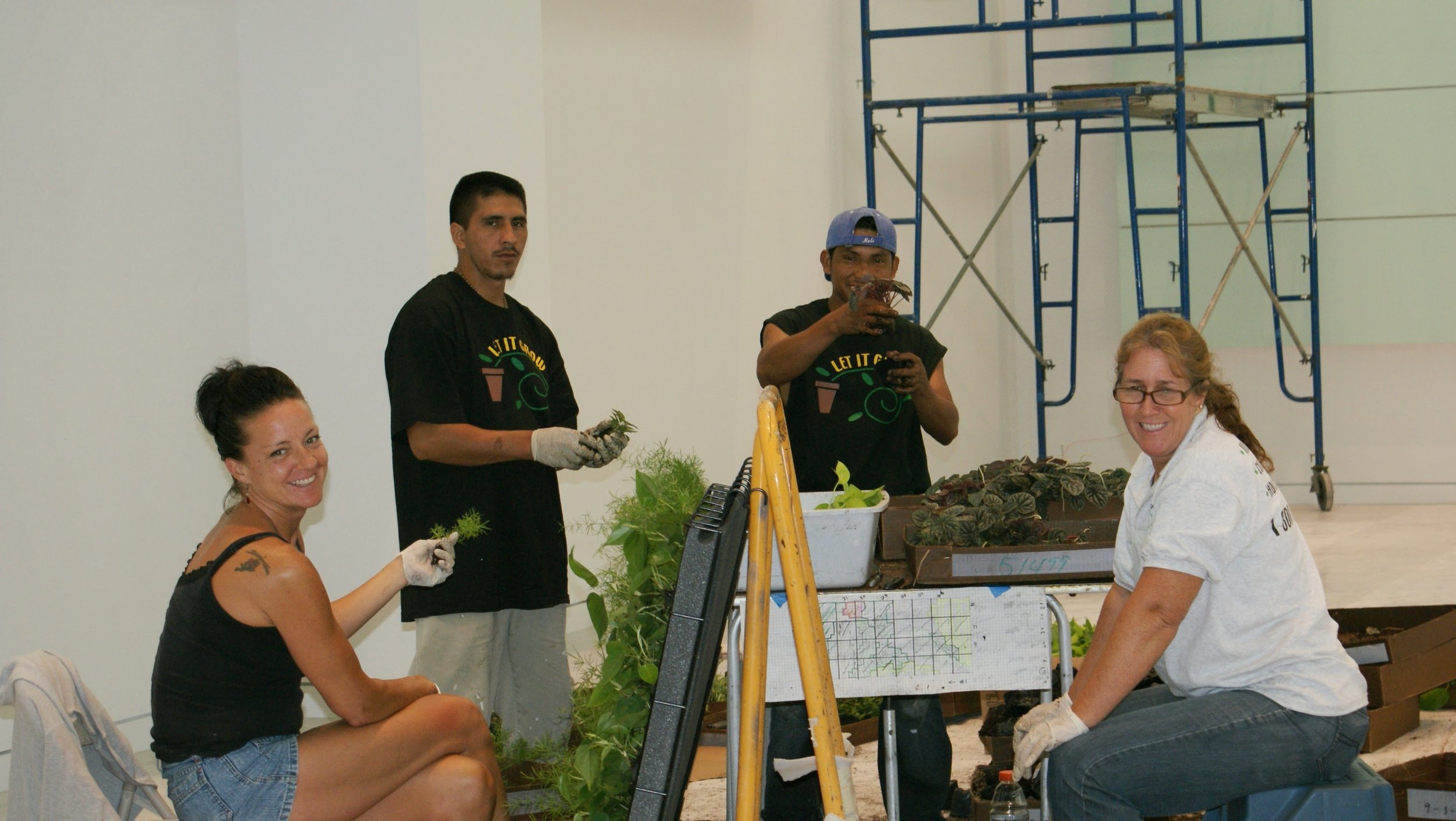
At NY Horticulture Group, we design, install, and maintain Brooklyn backyard gardens across Park Slope, Carroll Gardens, Clinton Hill, Williamsburg, Brooklyn Heights, DUMBO, and beyond. Our team includes horticulturists and designers who specialize in the realities of brownstone backyards — drainage, shade, access, and the kind of restrained design that fits Brooklyn architecture.
If you're trying to figure out what to do with your backyard — or what you keep getting wrong — we'd love to take a look.